Done poorly, by a provider who misrepresents their capabilities, applies outdated techniques, or optimises for the appearance of progress rather than for commercial outcomes, SEO can harm your organisation’s standing with Google in ways that take years to recover from. Algorithm penalties, whether algorithmic or manual, can suppress a domain’s organic visibility to a fraction of its previous performance overnight. The businesses that recover fastest are those that never accumulated the low-quality links, thin content, and keyword manipulation that triggered the problem in the first place.
This guide is written for corporate decision-makers who are evaluating SEO companies in South Africa and want a rigorous framework for making a decision they can stand behind. It covers what legitimate SEO work actually involves, how to distinguish genuine expertise from confident self-promotion, what questions to ask in a pitch meeting, how to evaluate results reports, and what realistic outcomes look like across a properly run engagement.
Before evaluating any provider, it is worth establishing a shared understanding of what SEO is and, equally importantly, what it is not. The discipline is frequently mischaracterised in both directions: oversimplified by providers selling it as a standardised service, and mystified by those who wish to create dependency by keeping their methodology opaque.
At its core, search engine optimisation is the practice of improving the relevance and authority signals that Google and other search engines use to determine whether a specific piece of content should appear in response to a specific search query. A searcher types a query. The search engine evaluates every page in its index against that query, using hundreds of signals to rank results in order of likely relevance and quality. The goal of SEO work is to ensure that the pages on your website are, by those signals, genuinely and demonstrably the best available answer to the queries your target audience is submitting.
That definition has an important implication: the most durable SEO outcomes come from websites that are genuinely excellent resources for the audiences they serve. Google’s ongoing algorithmic evolution, driven by systems including the Helpful Content update, the E-E-A-T quality guidelines, and the various versions of Panda and Penguin that preceded them, has consistently moved in the direction of rewarding authentic quality and penalising technical manipulation. The SEO company you choose should operate from this understanding, not from the assumption that search engines can be gamed indefinitely.
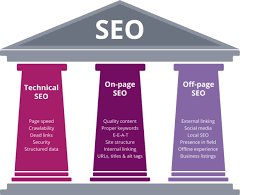
SEO is also not a single activity. It is a discipline that encompasses technical work, content strategy, and authority development simultaneously, and the interaction between these three pillars determines the ceiling of what any given domain can achieve in organic search. Understanding how a prospective search optimisation partner approaches each pillar, and how they prioritise and sequence the work across all three, is central to evaluating their capability.
On-page SEO: the relevance signals within each piece of content
On-page SEO encompasses the decisions made within individual pages that signal their relevance to specific search queries. These include the strategic selection of target keywords based on structured research into search volume, competition, and search intent, the integration of those keywords and their semantic variants into heading structure, body content, metadata, and image alt text in a way that reads naturally while communicating relevance clearly to the search engine.
Understanding search intent is the most consequential on-page SEO skill. A search query is not merely a string of words. It is an expression of a specific need at a specific moment in a buyer’s journey, and the type of need determines what kind of content will satisfy it. Informational queries, such as how does cloud ERP work, require educational content that explains thoroughly. Commercial investigation queries, such as best cloud ERP software for manufacturing, require comparative content that helps the searcher evaluate options. Transactional queries, such as cloud ERP implementation pricing South Africa, require content that facilitates a purchase or enquiry decision directly.
A content strategy built by a capable SEO agency maps the full landscape of queries your target audience submits across each stage of their decision journey and develops content specifically designed to be the most satisfying available answer to each category of query. This is a strategic exercise that goes well beyond keyword density optimisation, and it is one of the most meaningful differentiators between SEO companies that produce durable results and those that produce temporary ranking spikes.
The E-E-A-T framework, which stands for Experience, Expertise, Authoritativeness, and Trustworthiness, has become increasingly central to how Google evaluates content quality in competitive categories. For corporate websites in professional services, healthcare, finance, and legal sectors, Google applies heightened scrutiny to content quality signals because the stakes of poor information in these categories are high. An SEO partner working in these sectors must understand the specific requirements of E-E-A-T compliance: author credentials, editorial standards, transparent sourcing, and the organisational signals that establish institutional authority.
The characteristics that distinguish the best SEO companies from average ones are not primarily technical. Technical SEO knowledge is more accessible than it has ever been: documentation, training courses, and community resources are abundant. The differentiating factors are strategic, methodological, and cultural.
A genuinely capable search optimisation partner begins with a comprehensive audit of the current state before making any recommendations. This audit covers the technical health of the site, the existing keyword rankings and their trend direction, the quality and composition of the backlink profile, the content gaps relative to the target keyword landscape, and the competitive positions of the primary organic competitors. Without this baseline, any subsequent strategy is built on assumptions rather than evidence.
The strategy that emerges from this audit should be specific to the organisation, not templated. A corporate professional services firm competing for high-value, low-volume, high-intent keywords has fundamentally different requirements from a retail eCommerce business competing for high-volume, moderate-intent transactional queries. The content types, link building approaches, technical priorities, and measurement frameworks that are appropriate for each are quite different, and a provider that applies the same playbook to both is optimising for their own operational efficiency at the expense of the client’s results.
Communication and reporting quality is another significant differentiator. The best SEO agencies provide reporting that is transparent about what work was done, what results were produced, and how those results connect to the commercial outcomes the client cares about. They are willing to discuss what did not work as directly as what did, because the honest assessment of underperforming tactics is what enables strategic adjustment and long-term improvement. Providers that report only the positive signals and obscure or contextualise away the negative ones are managing the perception of performance rather than the performance itself.
A pitch meeting with a prospective SEO agency tells you almost nothing by default. Every provider can present case studies that reflect their best work, articulate a methodology that sounds compelling, and make promises that are unverifiable at the point of signing. The questions that reveal actual capability are the ones that cannot be answered with a slide deck.
How do you approach keyword research for a corporate brief?
A capable answer covers the specific tools and data sources used, the methodology for identifying keyword clusters around topics rather than individual terms, the process for understanding search intent behind different query types, the framework for prioritising keywords based on volume, competition, and commercial relevance, and the mechanism for validating keyword assumptions against actual business outcomes over time. An answer that mentions a single keyword research tool and moves on is insufficient.
Walk me through how you would audit a site you had just been engaged to optimise.
A genuinely experienced SEO partner will describe a structured, multi-stage audit process covering technical accessibility, indexation status, current ranking positions and their trend direction, content quality and gap analysis, backlink profile health and composition, competitive position relative to the primary organic competitors, and site speed and Core Web Vitals performance. They will mention the specific tools they use for each stage and explain how the audit findings inform the subsequent strategy. A vague answer that describes the audit as a general review of the site is a meaningful red flag.
What has been the most significant algorithm update to affect your clients in the past two years, and how did you respond?
Google releases multiple significant algorithm updates each year, including broad core updates that affect ranking across all categories and targeted updates addressing specific quality signals such as helpful content, link spam, and product reviews. An SEO company that is genuinely engaged with their craft will have a specific, detailed answer to this question: which update they observed having impact, which client categories were affected, what the diagnostic process looked like, and what adjustments they made to content strategy or technical configuration in response. A provider who cannot recall a specific update or describes their response in generalities is not as close to the discipline as they should be.
How do you build links for a corporate client in a competitive sector?
Link building is the area of SEO most susceptible to misrepresentation. The legitimate answer involves content development to attract editorial links, digital public relations to secure coverage on authoritative publications, relationship building with relevant organisations and industry bodies, and outreach-based placement on sites with genuine topical authority in the client’s domain. An answer that mentions directory submissions, profile link building, or any form of paid link placement should prompt immediate further questioning about the quality and permanence of the links being built.
What does a typical monthly reporting package look like, and what metrics do you prioritise?
The metrics that matter most in an SEO engagement are organic traffic volume and trend, keyword ranking positions and their movement over time for the target keyword set, organic click-through rates from search results pages, conversion events attributed to organic traffic, and the health indicators from Google Search Console covering crawl errors, mobile usability, and Core Web Vitals. A reporting package that focuses primarily on keyword rankings without connecting them to traffic and conversion outcomes is measuring activity rather than results.
Certain behaviours and claims reliably indicate that an SEO agency is not operating with the methodology or ethics that a corporate engagement requires. These are not subtle warning signs. They are direct indicators of misaligned incentives, insufficient expertise, or outright misrepresentation.
A guarantee of first-page rankings within a specific timeframe is the most widely recognised red flag in the industry. No legitimate SEO company can guarantee specific ranking positions because Google’s algorithm is not controlled by the provider. Rankings are the outcome of a competitive evaluation between multiple domains, each pursuing its own optimisation agenda, evaluated by an algorithm that updates continuously. A provider willing to make this guarantee is either uninformed about how search works or is promising something they have no intention of delivering.
Exceptionally low monthly retainer pricing, particularly for competitive corporate keyword categories, is another reliable indicator of a problematic engagement. Meaningful SEO work requires skilled human labour: keyword research, content strategy development, technical audit and remediation, outreach for link building, reporting analysis, and strategic adjustment. These activities cannot be delivered at a meaningful quality level for R1,000 per month. Providers offering retainers at this level are typically delivering automated reports, minimal strategy, and link building from sources that will harm rather than help the client’s organic standing over time.
Opacity about methodology is a structural red flag that many buyers overlook. An SEO agency that is unwilling to describe their link building approach in detail, that uses vague language about their content strategy process, or that declines to share the specific tools and data sources behind their recommendations is protecting a methodology that would not withstand scrutiny. Legitimate SEO work is fully describable and defensible. Providers with nothing to hide describe what they do.
The absence of reporting on negative signals is a subtler but equally significant problem. Google Search Console surfaces errors, manual actions, mobile usability issues, and Core Web Vitals failures that affect organic performance. An SEO company that delivers reports covering only positive ranking movements without addressing the issues Google has identified is curating the narrative rather than managing the asset.
One of the most common sources of disappointment in SEO engagements is the mismatch between buyer expectations and the realistic pace of organic search improvement. Corporate decision-makers accustomed to the immediate feedback loop of paid search advertising sometimes bring those expectations to an SEO engagement, and the first month of foundational work produces insufficient ranking movement to match them.
The realistic timeline for a well-executed corporate SEO programme unfolds across several distinct phases. The first two months are predominantly diagnostic and foundational: a comprehensive audit of the existing site, technical remediation of the issues identified, keyword research and strategy development, and the establishment of baseline measurement across all key metrics. Significant ranking movement during this phase is unusual and should not be expected.
Months three through six typically produce the first meaningful organic results as technical improvements are indexed, new and optimised content begins to accumulate authority, and the initial link building efforts start contributing to the domain’s backlink profile. Rankings for lower competition terms in the target keyword set typically begin moving during this phase, and organic traffic starts to show a measurable upward trend.
From month six onward, the compounding nature of organic search investment becomes increasingly evident. Content that has been indexed for several months accumulates more backlinks, more engagement signals, and more topical authority as it ages. Keywords that were ranking in positions 11 through 20 move onto the first page. Traffic from organic search grows at an accelerating rate as more pages rank for more terms. The commercial return per rand of investment improves continuously as the asset compounds.
This timeline assumes consistent, high-quality work across all three pillars of the SEO programme. Gaps in content production, pauses in link building activity, or deferred technical remediation slow the compounding process and extend the timeline for meaningful results.
Corporate buyers evaluating their options will encounter both independent SEO consultants and structured SEO agencies, and the distinction matters for how each type of engagement should be assessed.
An independent SEO consultant is typically a specialist with deep expertise in one or several dimensions of search optimisation, operating as a sole practitioner or with a small network of collaborators. The best consultants bring a level of domain expertise and personalised attention that is difficult to replicate in an agency model. They are often more transparent about their methodology, more direct in their communication, and more genuinely invested in the outcomes of each engagement because their reputation rests on it.
The structural limitations of the consultant model become relevant for corporate projects with broad requirements. A single consultant cannot simultaneously manage technical SEO at the depth a complex corporate site requires, develop and commission a content programme at the volume needed to build topical authority, run an outreach-based link building operation, and deliver structured monthly reporting without one or more of these dimensions receiving insufficient attention. Understanding which dimensions of the work will be handled directly and which will be subcontracted is an essential question for any corporate buyer evaluating a consultant engagement.
A structured SEO agency brings team depth, documented processes, and the operational infrastructure to run all three pillars of an SEO programme simultaneously at the scale required for corporate accounts. The tradeoff is that the individual working on the account may not have the depth of expertise of a specialist consultant, and the relationship between the account manager and the client may be more transactional than the consultant model. The answer to whether an agency or consultant is the right choice depends on the scope of the engagement, the internal technical sophistication of the client’s team, and the relative weight placed on depth versus breadth.
The contract and commercial structure of an SEO engagement significantly affects the quality of outcomes by either aligning or misaligning the provider’s incentives with the client’s commercial goals. A retainer structure that pays the same monthly fee regardless of results creates different incentives from a structure that ties a component of the fee to measurable performance improvements.
At minimum, a corporate SEO engagement contract should specify the scope of work in sufficient detail to make underperformance measurable and actionable. This means defining the number and type of content assets to be produced each month, the link building activities to be conducted and the quality criteria that govern them, the technical audit and remediation scope, the reporting cadence and the specific metrics to be covered, and the response time commitment for addressing Google Search Console errors and other emerging technical issues.
A quarterly review mechanism, where the strategy is evaluated against baseline and adjusted based on what the data shows, is a standard feature of well-structured SEO engagements. The market, the competition, and Google’s algorithm all evolve continuously, and an SEO programme that does not adapt to these changes will produce diminishing returns over time. The best search optimisation partners treat the quarterly review not as a reporting exercise but as a strategic conversation about where the next marginal unit of effort will produce the greatest incremental return.