
Web Design and Development: The Complete Guide for South African Businesses Planning a Digital Project
Web Design: The Strategic and Creative Discipline
User experience design
User experience design, commonly abbreviated to UX, is the strategic layer of web design. It begins with a clear definition of who the users of the platform are, what they are trying to accomplish when they arrive, and what obstacles currently prevent them from accomplishing it efficiently. The UX design process uses research methods including user interviews, analytics review, competitor analysis, and usability testing to build a detailed understanding of the current state and the design requirements of the improved state.
The outputs of UX design work include user personas that represent the primary audience segments with enough specificity to guide design decisions, user journey maps that trace the path from initial awareness through to conversion and retention for each persona, information architecture diagrams that define how content should be organised and navigated, and wireframes that translate these structural decisions into low-fidelity representations of each page layout. These outputs are the brief that the visual design and development work is built on, and their quality directly determines the quality of what follows.
A web project that skips the UX design phase, proceeding directly to visual design from a content outline, is building on assumptions rather than evidence. Those assumptions may be correct. More often, they are partially incorrect in ways that produce websites with good visual aesthetics and poor conversion performance: sites that look impressive but fail to guide their audience efficiently toward the actions the business values.
User interface design
User interface design, the UI layer of web design, is the visual execution of the UX strategy. It takes the structural decisions embedded in the wireframes and translates them into the specific visual language of the brand: the typography system, the colour application, the spacing and proportion relationships, the treatment of interactive elements, the visual hierarchy of each page, and the micro-interactions that provide feedback to users as they navigate.
UI design for a corporate website is not an exercise in creative expression unconstrained by practical considerations. It is a precise craft that must balance aesthetic ambition with functional requirements, brand consistency with contextual appropriateness, visual richness with performance implications, and the preferences of stakeholders with the demonstrated behaviours of the target audience. The best UI designers for corporate projects bring both visual sophistication and a deeply pragmatic understanding of how design decisions affect the technical build and the commercial outcomes of the platform.
The deliverables of UI design work include high-fidelity mockups of every unique page template, a comprehensive design system that documents the visual components, their states, their spacing rules, and their responsive behaviour across all viewport sizes, and an asset package that gives developers everything they need to build accurately from the approved designs. The completeness and quality of this design system is one of the most significant factors in the quality of the development output, since ambiguities in the design documentation are resolved by developers making arbitrary decisions that may not reflect the designer’s intent.
Web Development: The Technical Discipline
Web development is the practice of building functional digital systems from the design specifications produced by the web design process. It involves writing code that executes correctly across all intended browsers and devices, configuring the server environment and content management infrastructure that hosts and manages the platform, integrating third-party services and APIs that extend the platform’s functionality, and ensuring that the final product meets the performance, security, and accessibility standards that the project requires.
Front-end development
Front-end development is the layer of web development concerned with everything that happens in the user’s browser: the code that renders the visual interface, responds to user interactions, and communicates with server-side systems to retrieve and display data. Front-end developers work primarily in HTML, the markup language that structures page content; CSS, the styling language that controls visual presentation; and JavaScript, the programming language that enables interactive behaviour and dynamic content.
In 2026, front-end development for corporate projects almost always involves working with JavaScript frameworks or libraries that provide structured approaches to building complex, interactive interfaces. React, developed and maintained by Meta, is the most widely used of these and provides a component-based architecture that makes it practical to build and maintain large, complex front-end codebases. Vue.js and Angular are credible alternatives with their own structural approaches and developer communities. Next.js, built on top of React, has become a preferred choice for projects requiring server-side rendering or static site generation alongside client-side interactivity, as it provides the performance characteristics of server-rendered pages with the development experience of a component-based JavaScript framework.
The quality of front-end development work is most visible in its output: pages that render correctly across browsers and devices, interactive elements that respond predictably and appropriately to user actions, animations and transitions that enhance rather than distract from the user experience, and load performance that meets the Core Web Vitals benchmarks that directly affect both user experience and search visibility. Less visible but equally important is the quality of the code itself: its readability, its maintainability, and the degree to which it follows the conventions and patterns of the chosen framework consistently enough that another developer can understand and extend it without starting from scratch.
Back-end development
Back-end development is the layer of web development concerned with everything that happens on the server: the databases that store and retrieve content, the application logic that processes requests and generates responses, the APIs that connect the website to external services, and the infrastructure configuration that determines how the application scales, recovers from failures, and protects sensitive data.
For most corporate website projects built on established content management platforms such as WordPress or Webflow, the back-end development work involves configuring and extending the platform rather than writing a custom application from scratch. WordPress, built on PHP and MySQL, provides an extensible architecture that allows developers to create custom post types, custom fields, custom taxonomies, and custom application logic through a plugin and theme system that has been refined over two decades. This architecture enables sophisticated functional requirements to be met without the cost and timeline of fully custom back-end development, while retaining the editorial interface that non-technical content managers require.
For enterprise projects with requirements that exceed what standard CMS platforms can accommodate, custom back-end development using languages such as Python, Node.js, or PHP with frameworks such as Django, Express, or Laravel provides the flexibility to build precisely the data models, business logic, and API integrations that the project requires. The tradeoff is a longer development timeline, a higher initial cost, and a more complex ongoing maintenance obligation compared to platform-based approaches.
APIs and integrations
Modern corporate websites rarely operate as isolated systems. They exchange data with CRM platforms, marketing automation tools, accounting systems, ERP infrastructure, analytics platforms, payment processors, email service providers, and a range of other business systems that together constitute the organisation’s digital operations. The web development capability to design, build, and maintain these integrations is as important as the capability to build the front-end interface that users see.
RESTful APIs are the dominant integration standard for web-based systems, providing a structured protocol for reading and writing data between systems over HTTP. GraphQL, developed by Meta and adopted widely in the years since, provides a more flexible query interface that allows client applications to request precisely the data they need rather than receiving fixed data structures defined by the API provider. Webhooks provide a complementary mechanism for real-time event notification, allowing external systems to push data to a website immediately when a relevant event occurs rather than requiring the website to poll the external system for updates.
The quality of integration work is not visible to users under normal conditions, but it becomes dramatically visible when integrations fail. A contact form that silently fails to route submissions to the CRM, an eCommerce checkout that fails to update inventory in the ERP following a purchase, or an abandoned cart email that fires twice because a webhook was processed twice are all integration failures that cost the business money and erode customer trust. Building integrations with appropriate error handling, logging, and alerting is a mark of senior development capability that separates professional web development companies from those with a narrower technical view.
Why Design and Development Must Be Integrated, Not Sequential
Designers working without continuous input from developers make decisions that are technically impractical or disproportionately expensive to implement. A complex animation sequence that looks compelling in a static mockup may require a JavaScript implementation that significantly degrades page load performance. A layout that uses a non-standard grid system may require custom CSS that is fragile and difficult to maintain. A typography system with nine distinct type styles may be perfectly appropriate from a design perspective but creates a front-end implementation burden that a simpler system with six styles would avoid.
The Technology Landscape: Choosing the Right Stack for Your Project
Content management systems
WordPress remains the most widely deployed web platform in the world, powering a substantial proportion of all websites and the majority of professionally built corporate and eCommerce sites in South Africa. Its editorial interface is mature, well-documented, and familiar to a large pool of content managers and developers. Its plugin ecosystem provides pre-built solutions for a vast range of functional requirements. Its theme architecture enables sophisticated visual customisation. These characteristics make it the default choice for corporate projects where the editorial team needs a capable, accessible CMS and where the functional requirements can be met by a combination of core platform capabilities and well-maintained plugins.
Webflow occupies a distinctive position in the CMS landscape: it provides a visual design environment that gives designers direct control over the markup and styling of the site without requiring them to write code, while generating clean, semantic HTML that performs well in search. Its CMS capabilities are more constrained than WordPress but sufficient for many corporate content structures. For projects where the design team requires maximum visual control and the content structure is relatively straightforward, Webflow provides a compelling combination of design fidelity and editorial accessibility.
Headless CMS architectures, which separate the content management backend from the front-end presentation layer, have seen increasing adoption in enterprise contexts where the same content needs to be published to multiple channels simultaneously, where the front-end performance requirements exceed what traditional CMS rendering can achieve, or where the development team prefers to build the front-end in a JavaScript framework rather than within the constraints of a monolithic CMS theme system. Contentful, Sanity, and Strapi are among the headless CMS platforms most commonly used in South African enterprise projects, each with different strengths in terms of content modelling flexibility, editorial experience quality, and developer ecosystem maturity.
Front-end frameworks and when they are appropriate
The decision about whether to build a corporate website using a traditional CMS rendering approach or a modern JavaScript framework involves tradeoffs between development complexity, performance characteristics, and editorial capability. For the majority of corporate marketing websites, a well-configured WordPress or Webflow implementation provides better outcomes than a custom React or Next.js build, because the editorial flexibility, the maintenance familiarity, and the development speed of the platform approach outweigh the performance advantages of a fully custom front-end in most real-world scenarios.
Custom JavaScript framework development becomes genuinely appropriate when the project requires highly interactive application-like behaviour that a traditional server-rendered CMS cannot provide, when the performance requirements at scale demand the fine-grained optimisation control that a custom build enables, or when the website is one component of a larger digital product ecosystem that benefits from shared front-end architecture across multiple properties. For corporate websites whose primary function is marketing, information delivery, and lead generation, the argument for custom framework development must be made on specific technical grounds rather than on the assumption that newer technology produces better results.
The Full Project Lifecycle: What to Expect From Brief to Launch
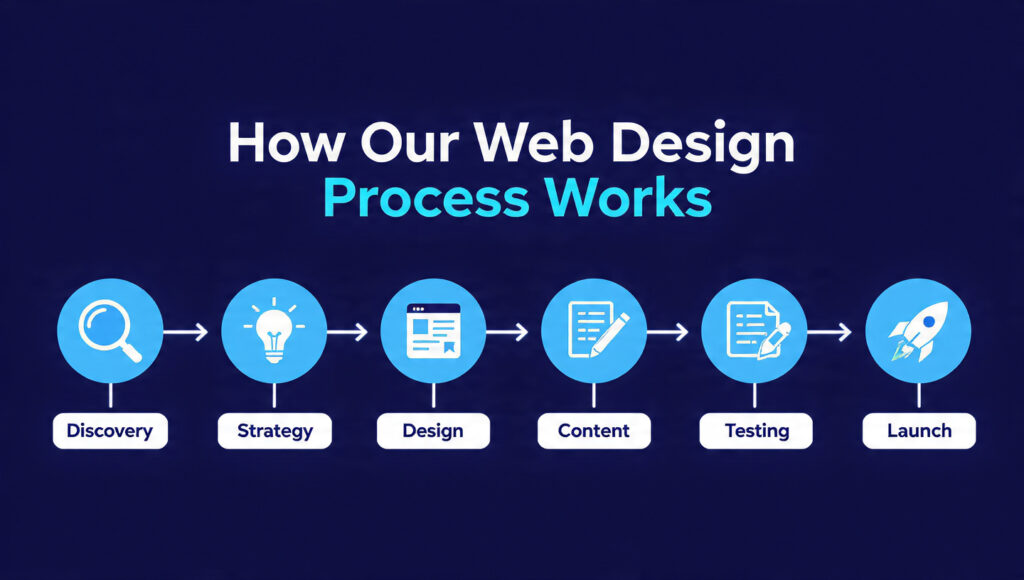
A professionally managed web design and development project progresses through a series of defined phases, each with specific outputs that must be reviewed and approved before the next phase begins. Understanding this lifecycle helps commissioning organisations set realistic expectations, prepare the inputs that each phase requires, and make timely decisions that keep the project on schedule.
Discovery and strategy
The discovery phase is where the project brief is translated into a shared understanding of what will be built, for whom, and to what standards. It involves structured workshops with key stakeholders to define business objectives, audience requirements, and success metrics; an audit of the existing digital presence and its performance; analysis of the competitive landscape; keyword research and SEO opportunity mapping; and a technical scoping exercise that defines the platform architecture, integration requirements, and functional specification.
The output of the discovery phase is a project specification document that is specific enough to serve as the basis for accurate timeline and budget planning, detailed enough to resolve the ambiguities that would otherwise surface as scope disputes during development, and comprehensive enough to align all stakeholders on what is being built before any design or development work begins. Organisations that resist investing in a thorough discovery phase in order to accelerate to design typically recover that time, and more, in revision rounds later.
Design phase
The design phase proceeds from the wireframes and information architecture produced in discovery through to high-fidelity visual designs and a comprehensive design system. It typically involves one or two rounds of client review at the wireframe stage, where structural and navigational decisions are evaluated before visual design investment is made, followed by one or two rounds of review at the visual design stage.
The design phase concludes with a design handoff package: completed design files in a format that developers can reference during build, an annotated design system documenting component specifications, a responsive design specification for each key breakpoint, and a clearly defined scope of what has been designed versus what will be interpreted by the development team using the design system as a guide.
Development phase
Development proceeds from the approved design system through front-end template build, CMS configuration, functionality development, and third-party integration. A well-run development phase uses version control throughout, with all code maintained in a Git repository that provides a complete history of changes and enables rollback when issues are introduced. Development work happens in a staging environment that mirrors the intended production configuration, allowing the client to review progress continuously without affecting any live systems.
User acceptance testing, the phase in which the client systematically tests the built platform against the agreed specification before sign-off, is a formal milestone that should be scheduled with adequate time allocated. Rushing the UAT phase to meet a launch deadline is the most common source of post-launch issues that require emergency remediation.
Launch and post-launch
A professionally managed launch involves a structured deployment checklist covering DNS configuration, SSL certificate provisioning, analytics tracking verification, sitemap submission to Google Search Console, performance testing, security scanning, and backup verification. The first four weeks after launch are a period of heightened monitoring, during which any issues that emerge under real-world traffic conditions can be identified and addressed before they compound.
Writing a Brief That Produces Good Outcomes
The quality of a web design and development project is substantially determined by the quality of the brief from which it begins. An incomplete brief produces a proposal that fills gaps with assumptions, a project that surfaces misalignments as costly scope changes, and a final product that is a reasonable interpretation of an ambiguous specification rather than a precise realisation of a clear vision.
A brief that produces good outcomes covers the business context in sufficient depth for the design and development team to understand the commercial purpose of the platform: what the organisation does, who it serves, what problems it solves, how the website currently performs against its commercial objectives, and what specific outcomes the new platform needs to achieve. It defines the primary audience segments with enough specificity to guide design decisions: not just their demographic characteristics but their digital behaviour, their decision-making process, and the specific tasks they need to complete on the platform.
A good brief specifies the functional requirements clearly enough that the development team can scope the build accurately without requiring a follow-up conversation for every component. It identifies the third-party systems that must be integrated and, where possible, provides documentation of the APIs involved. It states the technical constraints that apply: the CMS preference if one exists, the hosting environment if it is already defined, the browser and device support requirements, the accessibility standard to be met, and the performance benchmarks to be achieved.
A good brief also states what is out of scope, because scope creep is as damaging to project outcomes as an incomplete specification. A clear articulation of what the project will not include, agreed and documented before development begins, provides both parties with a shared reference point when new ideas emerge during the project and a decision framework for whether to accommodate them within the current scope or defer them to a future phase.
What Separates Excellent Web Development Companies From the Rest

The South African market for web design and development services includes a wide range of providers whose capabilities vary significantly beyond what is immediately apparent from portfolio review or pitch presentations. The characteristics that distinguish the most capable and reliable providers are not always the ones that are most visible during the evaluation process.
Process documentation is one of the most reliable indicators of operational maturity. A web development company that can describe its project methodology in specific detail, including how it manages scope changes, how it handles technical debt during a fast-moving build, how it conducts user acceptance testing, and how it manages the transition from build to ongoing support, is demonstrating the institutional experience that comes from having delivered many projects and learned systematically from the challenges encountered.
Code quality practices, including consistent use of version control, automated testing, code review processes, and documentation standards, are difficult to evaluate from the outside but have a large impact on the long-term value of the platform. A website built without version control is a platform that cannot be safely modified without the risk of irreversible changes. A codebase without documentation is a system that only its original authors can maintain efficiently. These practices add time to the initial build but reduce the total cost of ownership significantly over the lifetime of the platform.
Senior capability within the team matters considerably for complex corporate projects. The difference between a developer with two years of experience and one with ten years is not primarily the speed at which they write code. It is the depth of their architectural judgement: their ability to anticipate the second and third-order consequences of technical decisions made during the build, to recognise when a proposed approach will create maintainability problems later, and to navigate the tradeoffs between competing technical priorities in a way that serves the project’s long-term interests rather than just its immediate timeline.
The Build-Versus-Buy Decision: Custom Development or Platform Implementation
One of the most consequential decisions in any web design and development project is the degree to which the platform will be built from scratch versus configured from an established commercial or open-source platform. This decision affects development cost, time to launch, ongoing maintenance burden, flexibility for future evolution, and the availability of developer talent to support the platform over its lifetime.
The case for platform-based implementation, building on WordPress, Webflow, Shopify, or a comparable established system, rests on the substantial value embedded in these platforms: years of development effort by large teams, extensive testing across millions of installations, active security vulnerability management, a broad ecosystem of integrations and extensions, and a large pool of developers familiar with the platform. For the majority of corporate web projects, this embedded value makes a platform-based approach faster to deliver, lower in initial cost, and lower in long-term maintenance risk than custom development.
The case for custom development is strongest when the project’s functional requirements genuinely cannot be met by available platform solutions, when the performance requirements are extreme enough to justify the additional investment in bespoke front-end optimisation, or when the platform is one component of a larger proprietary digital product whose competitive advantage depends on technical differentiation. These cases exist, but they are far less common than the frequency with which custom development is proposed and commissioned suggests. The persuasive appeal of building something unique and the prestige associated with working on a bespoke codebase can sometimes drive platform decisions that would not survive a rigorous cost-benefit analysis.
Long-Term Thinking: Building for Evolution, Not Just for Launch
A corporate web platform built in 2026 will need to evolve significantly by 2028. The organisation’s service offering will change. The competitive landscape will shift. Google’s ranking algorithm will continue to develop. New device types and interaction paradigms will emerge. The content management team will develop more sophisticated requirements. The integration landscape will expand as the organisation adopts new business systems.
Platforms built with evolution in mind accommodate these changes efficiently. Their code is modular and well-documented. Their design system is a living resource that can be extended without requiring a full redesign. Their CMS configuration supports new content types without requiring database migrations. Their hosting infrastructure can scale to meet traffic growth without architectural changes. Their third-party integrations are built on stable, versioned APIs rather than fragile custom implementations.
Platforms built purely for immediate launch requirements accumulate technical debt at a rate proportional to how quickly the organisation evolves beyond them. The cost of that technical debt is paid in longer development times for incremental changes, increasing maintenance complexity, and eventually a rebuild that could have been avoided with better architectural decisions at the outset.
The web design and development company that serves a corporate organisation best is not the one that builds the most impressive platform for the initial brief. It is the one that builds the most intelligent platform for the brief and the three briefs that will follow it.
